

You're doing everything you were doing five years ago. The same sleep, the same walks, the same care taken with what you eat. So why does your skin look a little more tired than it used to? Why does the afternoon feel heavier than it did?
The change you're noticing isn't really happening on your face. It's happening several layers beneath it, inside your cells—and it's the same process whether it shows up as skin that's lost some bounce, energy that dips earlier, or digestion that's become a little less predictable.
This is cellular ageing. Here's what's actually going on.
What is cellular ageing?
Cellular ageing is the accumulation of damage and change inside your cells over time—damage that eventually outpaces your body's ability to repair it.
It's worth separating two ideas here. Your chronological age is fixed: it ticks over once a year regardless of anything you do. Your cells, though, don't all age at the same rate, and researchers now describe ageing not as one process but as a set of distinct biological changes happening in parallel. The Max Planck Institute for Biology of Ageing groups them into twelve hallmarks of ageing, each one a mechanism that has been shown to accelerate ageing when it worsens and slow it when it improves.
Twelve is a lot to hold in your head. Here are the six that matter most for how you look and feel.
1. Your DNA takes daily damage
Every cell in your body sustains DNA damage constantly—up to a million individual events a day, from sources including UV radiation and the reactive molecules your own metabolism produces. Almost all of it gets repaired almost immediately. That's normal, and it's been happening your whole life.
The issue is the small fraction that doesn't get repaired. It accumulates. Over decades, that unrepaired damage adds up to cells that function less well than they used to.
2. Your telomeres get shorter
At the end of each chromosome sits a protective cap called a telomere. The Australian Academy of Science describes them as being like the plastic tips on the ends of shoelaces—their job is to stop the ends of your chromosomes from fraying or sticking to each other.
Every time a cell divides, its telomeres get a little shorter. Once they reach a critical point, the cell stops dividing altogether. It becomes inactive and starts slowly accumulating damage it can no longer respond to properly.
This is one of the cleanest illustrations of cellular ageing there is: a physical, measurable countdown built into the structure of your DNA.
3. Your mitochondria produce less energy
Mitochondria are the power plants inside your cells. They're unusual—they carry their own separate DNA—and they're responsible for converting what you eat into usable cellular energy.
With age, they become less efficient. Fewer of them work properly, and the ones that do produce energy less cleanly, generating more reactive by-products in the process. If you've ever wondered why tiredness in your fifties feels different from tiredness in your twenties—less about sleep debt, more about a background flatness that rest doesn't fully fix—this is a large part of the answer.
It's also the mechanism behind the current scientific interest in NAD+, a molecule your cells need to make energy at all, and one that declines with age. We've written separately about NMN, the precursor your body uses to make it, and how to choose an NMN supplement in Australia.
4. Your epigenome drifts
Your DNA is the instruction manual. Your epigenome is the set of bookmarks and highlighting that determines which instructions get read in which cell—why a skin cell behaves like a skin cell and not a liver cell, despite both carrying identical DNA.
Unlike your DNA sequence, this layer is dynamic, and it shifts over a lifetime. Those shifts are so consistent that researchers can now estimate someone's biological age from a few hundred chemical markers on their DNA alone—an "epigenetic clock" that sometimes reads years away from the birthday on their licence.
5. Some of your cells stop retiring properly
When a cell is too damaged to keep dividing, it's supposed to shut down and be cleared away. Sometimes it doesn't. It lingers instead, no longer doing its job but still active enough to release signalling molecules that affect the healthy cells around it.
Researchers call these senescent cells, and their accumulation is one of the more consequential hallmarks—because a small number of them can affect the behaviour of an entire tissue.
6. Your gut microbiome loses diversity
This is the one most people don't expect on a list about cellular ageing, and it's the one closest to our heart.
The community of microorganisms living in your gut is remarkably diverse in youth. With age, that diversity tends to narrow—fewer species, less balance, a less resilient ecosystem. Given how much your gut does beyond digestion, from producing vitamins to shaping immune function, a narrowing microbiome has consequences well past your digestive comfort.
We've explored this properly in the gut-longevity connection, because it's the mechanism that sits closest to everything we've built as a brand. Beauty really does begin in the belly—and so, it turns out, does a good deal of how you age.
What does this look like from the outside?
All six of those processes are invisible. What isn't invisible is the result.
As Harvard Health notes in its overview of ageing, skin gets thinner and becomes less elastic, connective tissue between cells stiffens, and food moves more slowly through the digestive system. Collagen production slows, which is why skin that once bounced back now creases a little longer—something we cover in more detail in our guide to collagen protein powder. Energy production shifts. Even the mental fuzziness that can arrive in midlife has a cellular story behind it, which we unpack in brain fog.
None of this is a fault. It's biology working as designed. But the pace of it isn't entirely fixed.
Can you actually influence any of this?
Partly, and it's worth being clear about where the honest line sits.
You can't stop cells dividing, lengthen your telomeres by eating well, or reverse the drift in your epigenome. Anyone promising otherwise is ahead of the science.
What you can influence is the load you're placing on these systems, and the raw materials you're giving them to work with. The Australian Dietary Guidelines put it plainly: enjoy a wide variety of nutritious foods from the five food groups every day, with plenty of vegetables of different types and colours, and grain foods that are mostly wholegrain or high in cereal fibre.
That last point matters more than it sounds for the microbiome. CSIRO describes resistant starch as an insoluble fibre that is especially good at feeding beneficial gut bacteria, and notes that, when consumed alongside other dietary fibres, it helps keep your gut and the rest of your body healthy. Diversity of fibre, in other words, supports diversity of gut flora—the exact thing that narrows with age.
Add sun protection, regular movement, and sleep you actually protect, and you've addressed a meaningful share of the modifiable load.
Where Longevity Ritual™ fits
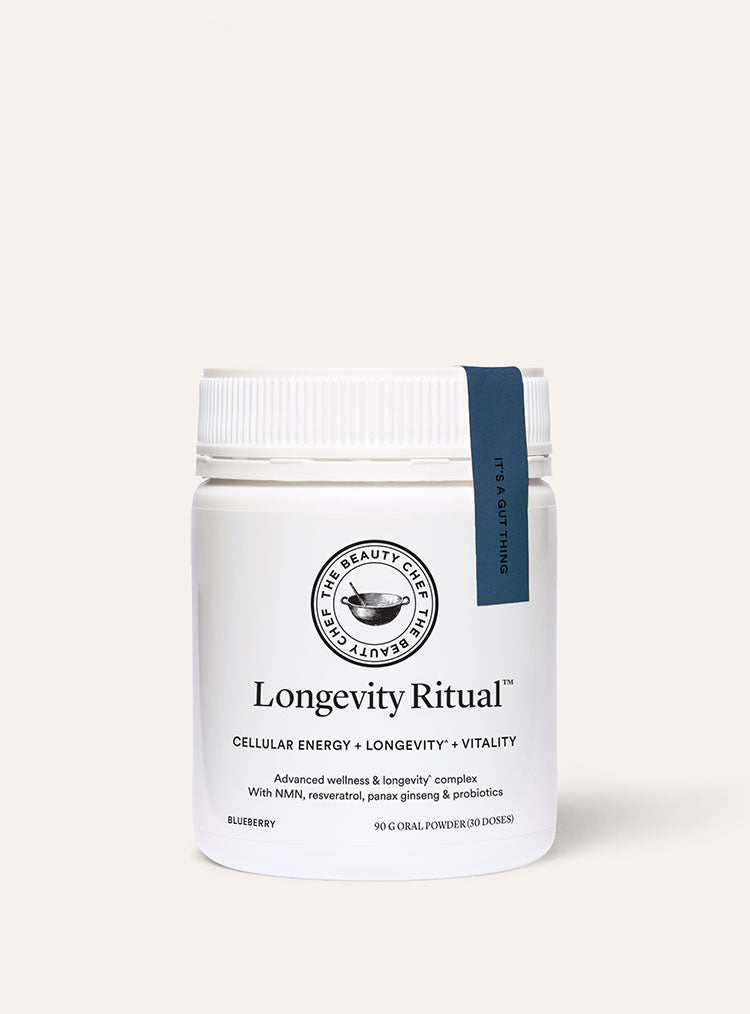
We built Longevity Ritual™ for this specific picture—not as an answer to any one hallmark, but as daily support for the systems underneath all of them.
It's formulated to support cellular energy production, vitality and the core biological systems that influence healthy ageing, in a multi-system formula powered by CellVive NMN®, fermented resveratrol, Panax ginseng and more than twelve active ingredients.
A few of those deserve a mention by name. Its antioxidants help reduce free radicals formed in the body and help reduce free-radical damage to body cells—relevant to the daily damage described above. Its B vitamins support energy levels and help relieve tiredness and fatigue. Panax ginseng has been used in traditional Chinese medicine as a longevity tonic and to enhance energy levels. And because we can't talk about ageing without talking about the gut, it includes Bacillus coagulans to support beneficial intestinal flora.
One caution worth stating plainly: no supplement lengthens a telomere or clears a senescent cell. What a well-built formula can do is support the systems that carry the load—energy, antioxidant defence, gut flora—consistently, over years. That consistency is the whole point of calling it a ritual.
Your questions, answered
At what age does cellular ageing start?
It's happening now, and it has been your whole life. Cells have been dividing, sustaining damage and repairing it since before you were born. What changes with age is the balance—repair gradually stops keeping pace with damage. Most people first notice the effects in their thirties or forties.
What are telomeres, in one sentence?
Protective caps on the ends of your chromosomes that stop them from fraying—and get shorter each time a cell divides.
Is cellular ageing the same as skin ageing?
Skin ageing is one visible expression of it. The cellular processes described above affect every tissue you have; skin is simply the one you can see in the mirror.
Can supplements slow cellular ageing?
No supplement has been shown to stop or reverse the mechanisms of cellular ageing, and you should be sceptical of anything claiming to. What a formula can do is support the systems involved—cellular energy, antioxidant defence and gut flora—as part of a diet and lifestyle that already does the heavy lifting.