

We tend to look for ageing in the mirror. The first place it actually shows up may be somewhere you cannot see at all.
Your gut is home to trillions of microbes, and that community does not stay the same across a lifetime. It shifts—sometimes quietly, sometimes considerably—and those shifts touch far more than digestion. At The Beauty Chef, we have always believed that health, wellbeing and vitality begin in the gut. Here is what that means when the subject turns to ageing.
What Happens to Your Gut as You Age?
The gut microbiome is a living ecosystem, and like any ecosystem, its health rests heavily on diversity. Research reviewing the gut microbiota and ageing describes a broad pattern in which microbial diversity tends to decline with age, alongside a loss of some of the beneficial bacteria that produce short-chain fatty acids—compounds that help maintain the gut lining.
None of this is a diagnosis, and it is not uniform. Diet, movement, sleep, stress, medication and antibiotics all shape the picture, which is precisely why the day-to-day habits matter so much.
The Gut-Ageing Connection
Inflammation
Nutrient Absorption
This is the connection we find most persuasive, and the one most often overlooked. You are not nourished by what you eat and what you absorb. Your gut is where that happens, so a well-supported microbiome affects the benefits you actually receive from a nourishing diet and the supplements you invest in. It is a quiet multiplier on everything else you do.
Your Skin
Beauty begins in the belly, and this is the mechanism behind that phrase. Skin is an outward expression of what is happening within, which is why we have always started with the gut rather than making it an afterthought. We have written more about that in the link between acne and gut health.
How to Support your Gut for Healthy Ageing
The foundations are unglamorous and genuinely effective.
- Eat for diversity. Different plants feed different microbes. Healthdirect notes that foods high in fibre help good bacteria grow—vegetables, fruit, beans and legumes, and whole grains. Variety across the week does more than volume on any single day.
- Add fermented foods. Yoghurt, kefir, sauerkraut, kimchi and miso are a daily habit worth building. Bio-fermentation has been at the heart of what we do since the beginning.
- Sleep and move. Both influence the gut, and neither can be supplemented around.
- Manage stress. The gut and the nervous system are in constant conversation.
- Consider a probiotic. Live cultures can support beneficial gut flora as part of an overall approach—not instead of one.
Where Longevity Ritual™ fits in
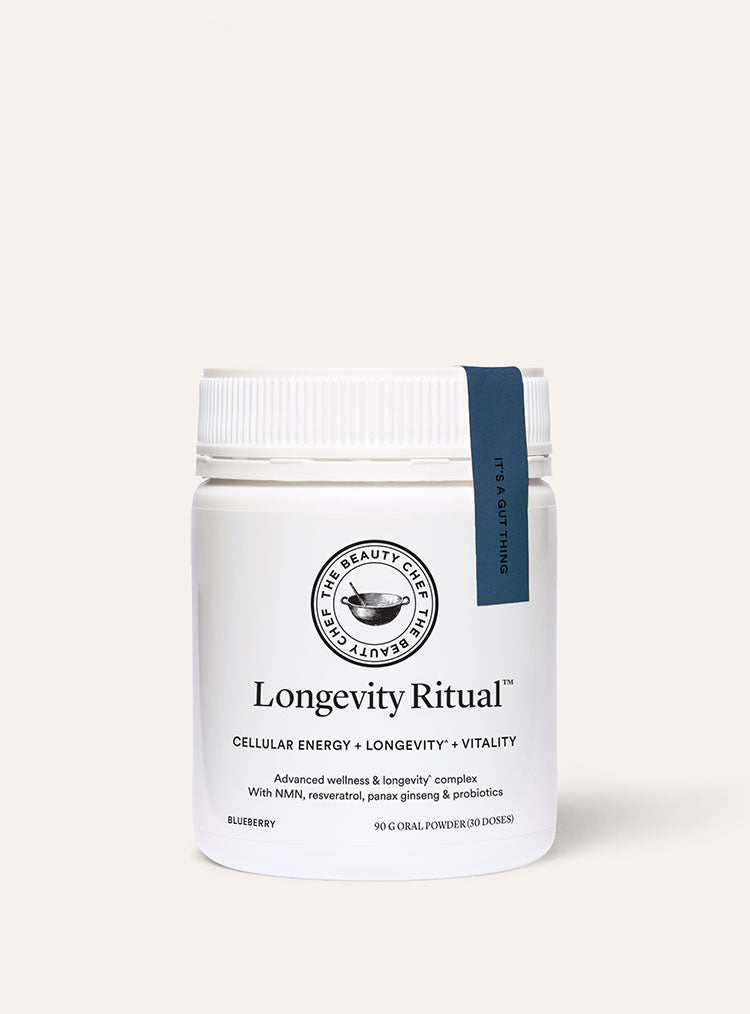
If the gut is where ageing well begins, a longevity formula ought to start there too. That belief is the reason Longevity Ritual™ contains Bacillus coagulans, chosen to support gut microbial diversity and digestive wellbeing.
Around that sits a formula built for the whole system.
- 250 mg of CellVive NMN®, which is a direct precursor to NAD+—a coenzyme essential for cellular energy production.
- Panax ginseng—traditionally used in Chinese medicine as a longevity tonic to help replenish life force.
- MenaQ7™ vitamin K2 supports bone health and vitamin D3 supports muscle health.
- Silica supports skin integrity, firmness and elasticity.
- Vitamin C boosts collagen formation.
- Fermented resveratrol and polyphenol-rich pomegranate peel work with vitamin C to help protect against free radical damage.
- Zinc supports cognitive function.
- Activated vitamin B6 supports healthy emotional and mood balance.
It is one delicious, blueberry-flavoured powder, designed the way we design everything—synergistically, and from the gut outwards.
The bottom line
How you age is a whole-body process, and your gut sits closer to the centre of it than most conversations allow. A diverse microbiome supports the gut barrier, shapes how well you absorb the nutrients you take in and shows up—eventually—in your skin. You cannot control every part of ageing. You can absolutely feed, rest and support the ecosystem doing so much of the quiet work.
Ready to support healthy ageing from the gut out? Discover Longevity Ritual™
Your questions, answered
How does your gut microbiome affect the ageing process?
Microbial diversity tends to decline with age, and reviews of the gut microbiota and ageing associate that shift with low-grade inflammation, a less robust gut barrier and changes in how well nutrients are absorbed. Because absorption underpins everything else, the gut influences far more than digestion alone.
Does gut inflammation speed up ageing?
Researchers describe an association between age-related microbiome shifts and heightened inflammation, rather than a simple cause and effect. Supporting a diverse microbiome through fibre, fermented foods, sleep and stress management is the practical response.
What is the gut-skin-ageing connection?
Skin reflects what is happening inside. Nutrient absorption and the gut barrier both influence skin health, which is why we start with the gut rather than seeing it as something separate.
How do probiotics support healthy ageing?
Probiotics support beneficial gut flora and gastrointestinal health. They are one supportive part of an overall approach to ageing well—alongside a diverse diet, movement and rest—not a shortcut around it.
What role does Bacillus coagulans play in gut health?
Bacillus coagulans is a spore-forming probiotic that supports beneficial intestinal flora and digestive wellbeing.